March 24th, 2026
New
Improved
Fixed
Vero 2.0

Not every update is a headline feature — and we're okay with that. Some of the most meaningful improvements are the ones that make Vero feel sharper to use every day: keyboard shortcuts, better sorting so the right things surface first, fewer rough edges. There's plenty of bigger things in the works, but we know the small stuff matters too. We hope the updates shared today makes your day-to-day a little easier.
New: Command Palette – Hit ⌘K (or Ctrl+K) in Vero 2.0 to show a command menu with options to quickly navigate to any part of Vero using just the keyboard. Right now it covers all the main sections of the app, and we'll be adding more shortcuts over time to make getting around even faster.
New: Forms – Forms have been a staple of Vero 1.0 for a long time, and they're now fully manageable in Vero 2.0. All your existing forms carry over, and the new UI is a lot nicer to work with.
New: Profile Activity Exports – You can now export a full CSV of any user profile's activity — every tracked action and message interaction — straight from the profile activity tab in Vero 2.0.
New: Exports Page – There's now a dedicated page in Vero 2.0 to view and manage all your exports, including those from Vero 1.0. Exports that take a little time to generate will appear here with a secure, expiring download link.
New: Campaign Celebration 🎉 – We added a little confetti moment when you send a broadcast or launch a journey. You've done the work — we figured it deserved a proper send-off.
Improved: Campaign and Profile List Sorting – Lists in Vero 2.0 now default to sorting by last updated, so what you're actively working on is always front and centre. A new sort menu gives you better visibility of the ordering and more sorting options too.
Fixed: Profile Merge Race Condition – Fixed a bug that in some rare cases could cause both profiles to be deleted during a concurrent merge operation.
Fixed: Conditions Disappearing on Resize – Fixed a bug where in some cases unsaved segment conditions would disappear when resizing the browser window.
March 23rd, 2026
New
Vero 2.0
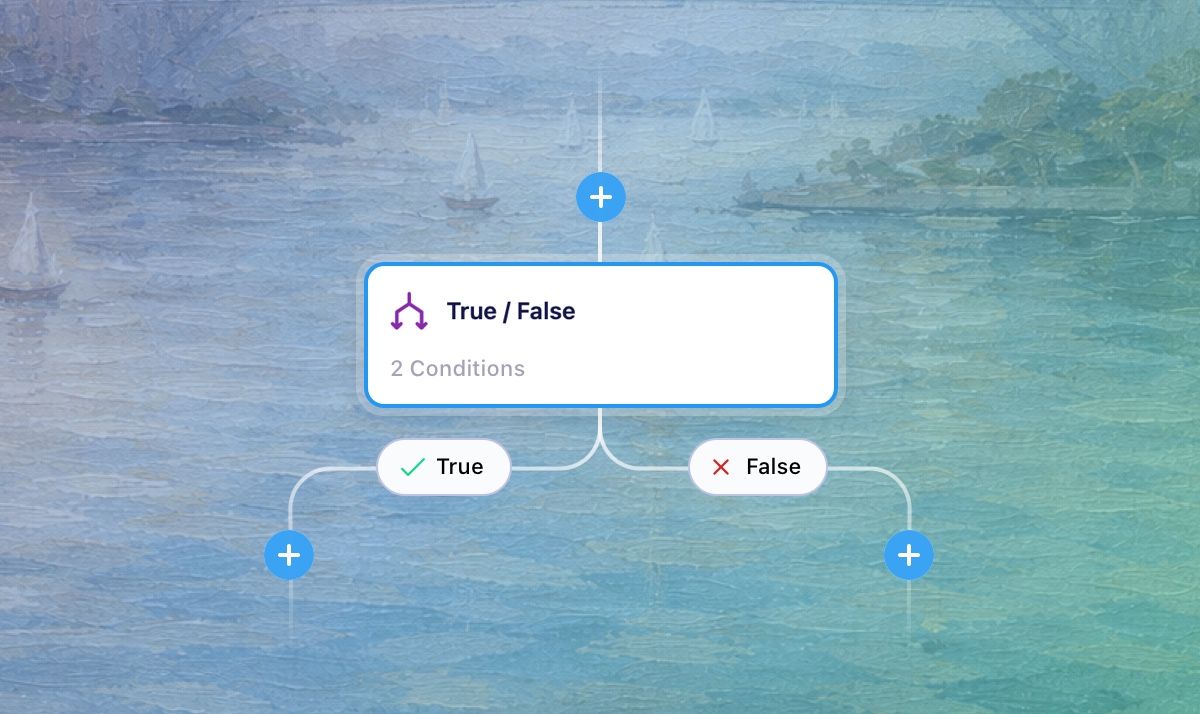
True/False and Exit nodes are now live in Vero 2.0 Journeys. You can now build conditional workflows that route customers down different paths based on their behaviour, properties, and actions — bringing true branching logic to Vero 2.0 Journeys for the first time.
True/False node
This node works as a branch in your Journey, evaluating conditions at the point a customer reaches it and routing them down one of two paths. You can build branching logic using the same conditions available in Segments — including user properties, event history, message interactions, and segment membership — giving you precise control over how customers move through your campaigns.
Branches automatically rejoin after both paths complete, so there's no need to manually connect them. You can also nest branches inside branches to build more complex journeys.
Read more about True/False nodes in our help docs
Exit node
The Exit node gives you a clear, explicit way to remove customers from a Journey at a specific point. When combined with a True/False node, it achieves the same filtering behaviour as the Filter node in Vero 1.0 Workflows — with the added benefit of making exit points clearly visible on the canvas, so the logic of your Journey is easier to read and reason about.
Read more about the Exit node in our help docs
Journey-specific conditions
True/False nodes support two conditions unique to Journeys:
Trigger event property — branch based on a property of the event that originally triggered the Journey
Has not performed event since entering this Journey — branch based on whether a customer has taken an action since the Journey began
Getting started
To start using True/False and Exit nodes, open any Journey in Vero 2.0 and use the + button to add a True/False node to your canvas. From there, define your conditions using the condition builder and optionally add an Exit node to the end of either path.
For any questions don't hesitate to reach out to support@getvero.com
March 6th, 2026
New
Vero 2.0
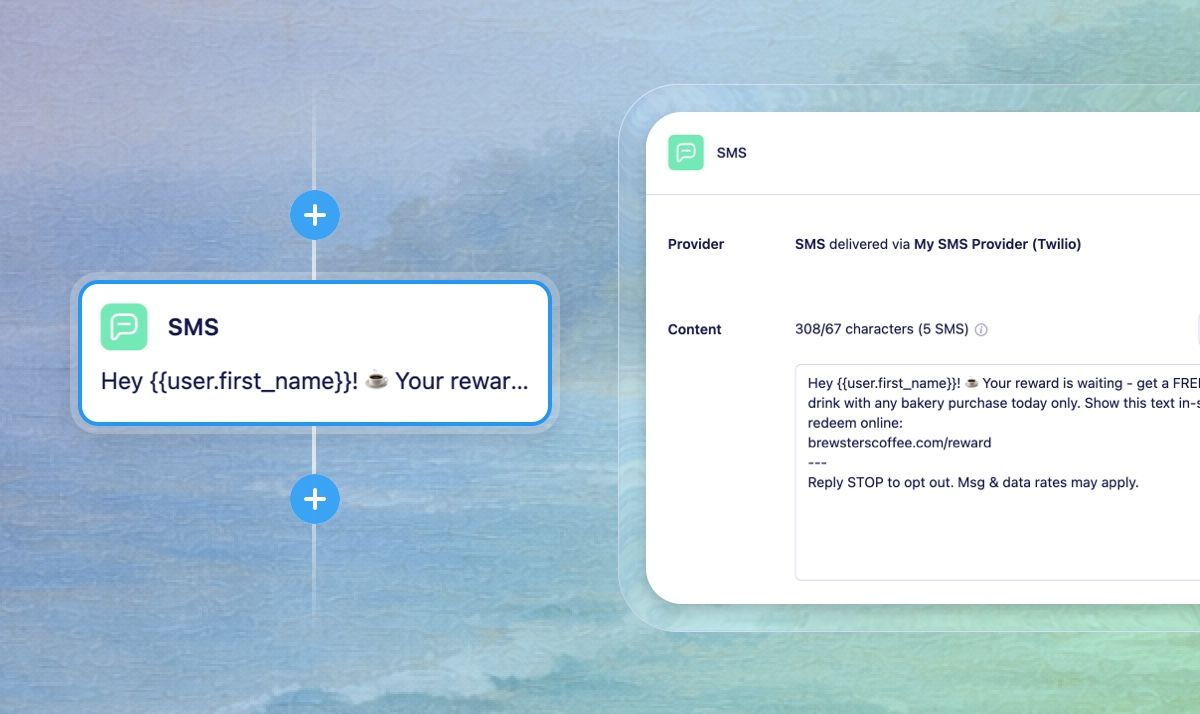
We're excited to share that SMS is now available in Journeys in Vero 2.0. You can now include text messages in your automated workflows, adding SMS to your multi-channel marketing strategy alongside email.
What's new
SMS node in Journeys
Journeys now supports SMS messaging with a dedicated SMS node. You can build automated SMS workflows triggered by user events and behavior, allowing you to send timely, personalized text messages based on customer actions. Whether you're sending order confirmations, appointment reminders, cart abandonment messages, or follow-ups, SMS gives you a direct line to your customers as part of sophisticated, multi-step campaigns.
Learn how to add an SMS node to your journeys
Phone number tracking
You can now track and store phone numbers for your users via the API using the phone_number property. Phone numbers are displayed in user profiles and used as the channel address for SMS campaigns, giving you a complete view of how to reach each customer. This unlocks the ability to send automated SMS messages in Journeys to users who have been identified with a phone number.
Learn how to track phone numbers to user profiles
Getting started
To start sending SMS messages in Journeys, you'll need to:
Track phone numbers for your users via the API using the
phone_numberpropertyConfigure your SMS provider in Vero 2.0 settings
Add SMS nodes to your Journeys and craft your messages
For any questions don’t hesitate to reach out to support@getvero.com
March 6th, 2026
New
Improved
Fixed
Vero 1.0
Vero 2.0

Alongside SMS journey nodes and our new help docs, here's what else was shipped across Vero 1.0 and 2.0 this cycle — featuring some new features, performance upgrades, and a few reliability fixes.
Vero 2.0
New: Conversion goals – You can now set conversion goals on campaigns in Vero 2.0 and track how your messages drive customer actions. When you assign an event as a conversion goal, Vero automatically tracks direct, indirect, and view-through conversions for that campaign. Conversion data appears on each campaign's insights page, giving you clear visibility into which messages are driving the outcomes that matter to your business. This brings the powerful conversion tracking functionality from Vero 1.0 into Vero 2.0's improved interface. Learn how to add a conversion goal
New: Drag-and-drop segment conditions – Building complex segments just got easier. You can now reorder conditions within a group or move conditions between groups using drag-and-drop, giving you more control and flexibility when organizing your segment logic.
Improved: Event occurrence performance – We've upgraded our event data infrastructure, significantly improving query performance and reliability when viewing user activity and building event-based segments. You'll notice faster load times when exploring event histories and creating event-based conditions.
Improved: A/B test summaries – A/B test results now display more comprehensive details alongside performance metrics, making it easier to understand exactly what was tested and compare variant settings at a glance.
Improved: Queued activity log – Activity logs now include a "queued" status, giving you better visibility into message processing stages and helping you understand where messages are in the delivery pipeline.
Fixed: Data feed validation errors – Resolved a bug that incorrectly flagged valid URLs when adding a data feed with variables, preventing you from saving legitimate configurations
Fixed: Segments stuck in refreshing state – Fixed a bug that caused segments to remain stuck in a refreshing state, preventing you from using them in campaigns.
Fixed: User property timestamps – Resolved an issue where user property timestamps could be lost during retry operations, ensuring accurate tracking of when properties were last updated.
Vero 1.0
Improved: Email attachment handling – Updated our managed sending infrastructure to prevent attachments from being incorrectly inlined in some cases, ensuring your email attachments display as intended.
Improved: Mandrill webhook compatibility – Updated the Mandrill webhook schema to handle edge cases more gracefully. The subject field is now optional, and tags and metadata fields can accept empty values. This prevents validation errors when processing legitimate webhook payloads from emails that don't have subjects, tags, or metadata, improving integration reliability.
Improved: Webhook validation – Fixed webhook validation to properly handle edge cases, reducing failed webhook deliveries and improving integration reliability.
Fixed: Segment export failures – Resolved an issue that was causing some segment exports to fail.
March 6th, 2026
New
Vero 1.0
Vero 2.0
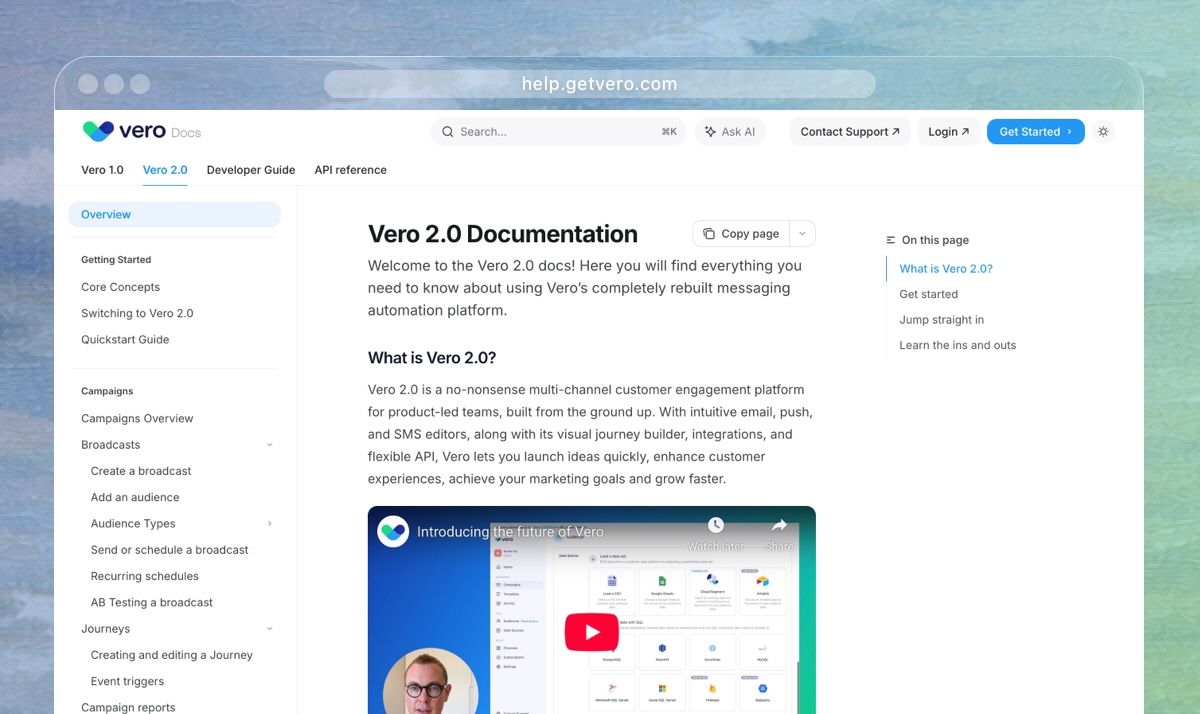
We've completely rebuilt our help documentation with a fresh new look, improved structure, and powerful new features to help you find answers faster.
What's new
Modern documentation platform
Our help docs now run on a new platform that's faster, easier to navigate, and designed for a better reading experience. The updated interface makes it simple to browse topics, jump between sections, and find what you need.
AI-powered help chat
Get instant answers with our new AI help chat. Ask questions in natural language and receive relevant responses drawn from our documentation, helping you solve problems without having to search through multiple articles.
Improved search
Finding the right help article is now faster and more accurate. Our enhanced search understands your queries better and surfaces the most relevant results, so you spend less time hunting and more time getting answers.
Better organization and updated content
We've reorganized our documentation with clearer navigation and updated key articles to reflect the latest features and best practices. Whether you're learning about Segments 2.0, Journeys, or any other Vero feature, you'll find more comprehensive, easier-to-follow guidance.
February 12th, 2026
Improved
Vero 2.0
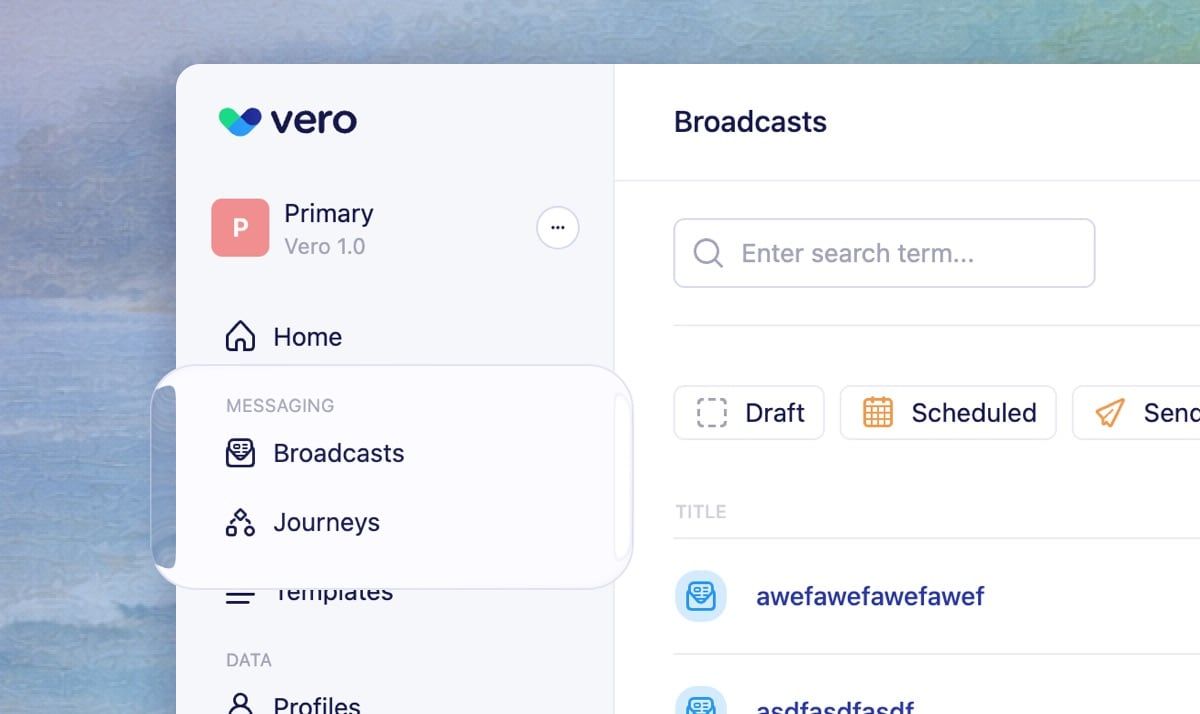
Today we're excited to share improvements to how campaigns are organized and named in Vero 2.0. These updates make it easier to understand the different types of campaigns you can create and help you find what you're looking for faster.
What's changed:
Single message campaigns are now called "Broadcasts" throughout Vero 2.0.
This new name better reflects their purpose: scheduled, one-to-many messages like newsletters and announcements. It distinguishes them from automated, event-driven campaigns (Journeys) and more accurately describes how these campaigns work, rather than focusing solely on their single-send nature.
Dedicated navigation for each type of campaign
Broadcasts and Journeys now have their own sections in the main sidebar navigation, with separate campaign lists at /broadcasts and /journeys. Previously, both campaign types were mixed together in a single list. Now, similar to Vero 1.0, each has its own dedicated page, making it easier to organize, find, and manage your campaigns based on type.
What hasn't changed
Vero 1.0 remains the same
These updates only affect Vero 2.0. If you're still using Vero 1.0, your campaigns, navigation, and terminology remain unchanged. These improvements are part of our ongoing work to make Vero 2.0 more intuitive and powerful as we prepare for the eventual migration from Vero 1.0 to Vero 2.0. We'll share more details about the migration timeline and process as we get closer.
January 8th, 2026
New
Improved
Vero 1.0
Vero 2.0
Happy New Year everyone! Here's what we've shipped over the past few weeks to start 2026 strong.
Vero 2.0
New: Events in Vero 2.0 - We've rebuilt the events experience from Vero 1.0 for Vero 2.0. You can now view and search all events tracked in each project with a fully searchable table that makes it easy to find specific events. Click into any event to see detailed information including which campaigns use that event as a trigger, event properties from the last tracked event and a list of users who have recently performed the event.
New: Journey node duplication - You can now duplicate nodes in your Journeys with a single click making it faster to build complex Journey workflows.
Improved: Segment selection in audience imports - The segment dropdown when importing audiences now uses the same query system as the segment condition editor. This means newly created segments appear immediately in the dropdown without needing to refresh the page.
Fixed: Profile ID display errors - Fixed a bug where very large profile ID numbers caused broken links on log and event detail pages. All profile links now work correctly regardless of ID size.
Fixed: MySQL query compatibility - Resolved an issue where some queries with MySQL specific syntaxes are being rejected as invalid. These queries now work as expected.
Security & Infrastructure
Improved: Platform security - We've shipped several security enhancements to strengthen account protections and access controls across the platform.
Improved: Platform performance - We've made several behind-the-scenes improvements to enhance platform stability and performance, including optimized database query handling and enhanced service reliability with improved retry logic.
December 10th, 2025
Improved
Fixed
Vero 1.0
Vero 2.0
Here’s a round up of some of the fixes and minor releases we’ve made over the last few weeks. We’re currently running QA over our new Journeys feature in Vero 2.0 and will release this as soon as we’re comfortable it’s ready for production. Stay tuned!
Vero 2.0
Fixed: Minor Segments UX issues. Fixed several small but noticeable UI and UX issues with the new Segments 2.0 release.
New: Snowflake key-based authentication. Added key-based authentication for Snowflake connections.
Improved: ETL speed. Improved performance of initial syncs for ETL transfers from Vero to BigQuery, Snowflake, and other data warehouses.
Both Vero 1.0 and Vero 2.0
Improved: Webhook speed. Migrated several high-traffic data lookups to a faster, more scalable backend. This reduces latency in overall webhook processing (for webhooks sent from Vero to our customers, Twilio Segment, etc.)
Fixed: Edge case regarding inaccurate merges. Improved “locking” to ensure reliability of person merges and prevent some (very) rare merge concurrency edge cases.
Improved: Provider statistics integration. Configuring external sending providers like Sendgrid and Mailgun now runs through new infrastructure, improving reliability during setup and ensuring smoother delivery of message results (sent, delivered, opened, clicked, etc.)
Bonus extra
Our CEO, Chris, released a little tool that enables you to convert Markdown or MDX files to fully-rendered HTML emails.
Check out Chris’ LinkedIn post here.
Check out the code repository here: github.com/getvero/mdx-to-email.
Whilst not part of the core product, this is a powerful, fun internal tool we use have started using ourselves and hope it resonates with others (in which case we’ll build into Vero).
November 27th, 2025
Improved
Fixed
Vero 1.0
Vero 2.0
Last week we shipped Segments in Vero 2.0, a major update that improves the segmentation experience and unlocks new capabilities coming soon. In the meantime, here are a few smaller updates we've made since our last post:
Vero 2.0
Improved: Journey node stats - Message nodes now display stats (Sent, Delivered, Opened, Clicked, Unsubscribed) directly in the canvas for live or stopped Journeys, no need to visit the reports page.
Improved: Segment validation - Enhanced validation for timestamp and number values used with comparison operators in the segment condition builder, reducing errors and incorrect results.
Vero 1.0
Improved: "All customers" safeguards - Based on feedback, we've made the ability to send to "All customers" less prominent when selecting newsletter audiences and added confirmation warnings for this action.
Fixed: Tag name character limit - Tag names are now limited to 255 characters when importing user data. This also applies to Vero 2.0.
Fixed: Segment refreshing - Resolved an issue causing segments with 'in segment' conditions to refresh slowly before campaign sends.
Fixed: UI performance - Addressed platform issues causing UI slowdowns. We've increased resources and added monitoring to prevent future occurrences.
November 17th, 2025
New
Vero 2.0
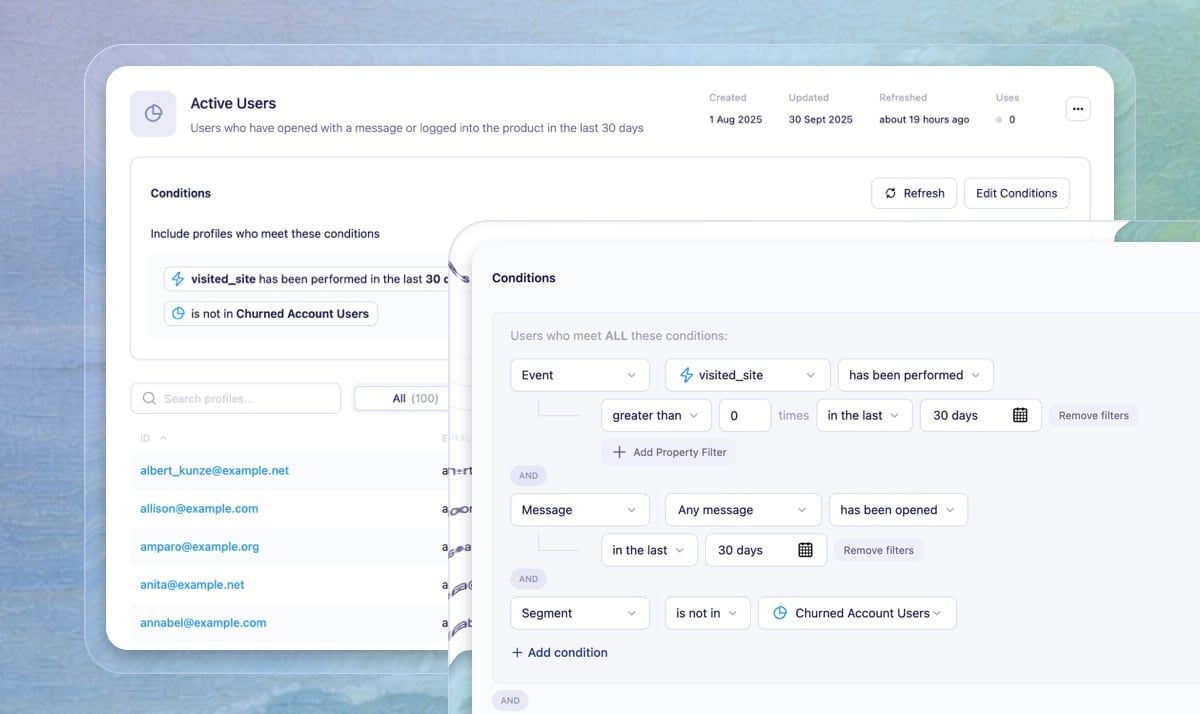
Today we’re excited to share that Segments 2.0 is now live in Vero 2.0. This update brings all of the segmentation power you know from Vero 1.0—now rebuilt with a cleaner interface, clearer wording, and a more intuitive segment building workflow. Segments 2.0 is a complete rebuild that builds on the best parts of Vero 1.0’s segmentation experience, refining the interface and structure to offer a smoother, more flexible way to create and manage your customer segments.
You’ll still find all the functionality you rely on from Vero 1.0, now with meaningful UX and UI improvements that make segment building clearer and faster. This release also lays the groundwork for future enhancements designed to enhance your control and flexibility, enabling capabilities that weren’t achievable with our previous segmentation system. Such as including expanded logic controls, multi-property filtering, and richer date-range options.
We’re looking forward to rolling out more updates to segments in the future, but in the meantime, here’s what’s new today.
Key updates include:
Unified event conditions
Event-based segmentation is now consolidated into a single event condition with optional filters for event properties, time and date, and frequency.
Description field for segments
Add helpful descriptions to keep your segments well-documented and easy for your team to identify.
Improved search across all inputs
Faster, smarter search ensures you can quickly find properties, events, and values while building conditions.
Campaign browsing upgrades
A refined browsing experience makes it easier to locate campaigns and messages, with a dedicated section for recently selected messages.
Condition cloning
Duplicate conditions with a single click to speed up segment creation and experimentation.
A stronger foundation for what’s coming next
Today’s release sets the stage for multiple property filters within a single condition, flexible AND/OR groups, and more interactive date-range options.
Backwards compatibility
All of your existing Vero 1.0 segments are fully compatible with Segments 2.0. They’re now visible and editable directly inside Vero 2.0, and any updates you make in either version will sync automatically.
That means there’s nothing you need to migrate or update. Your campaigns continue running seamlessly across both platforms until the full transition to Vero 2.0 is complete.